in-conversation
in conversation with Talie Gray
by Josephine Kiaga
September 02, 2025
in-conversation
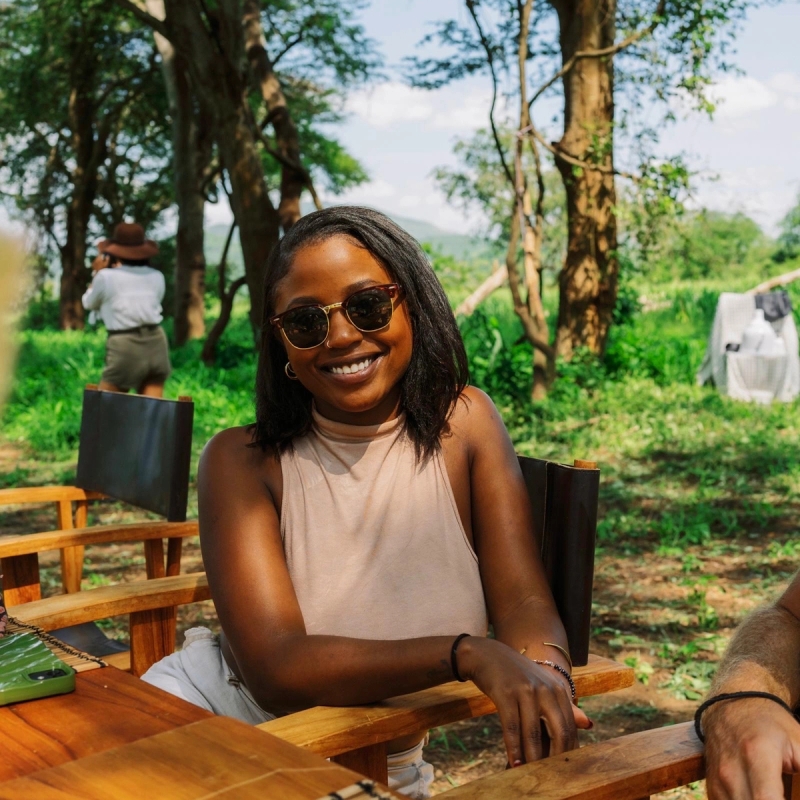
In this interview, I was joined by 2025 ZIFF Actress of the Year, Talie Gray, best known for her performance as Nuru in Tanzania’s premiere romantic comedy Netflix film, ‘The Christmas Run’. Talie dives into her evolution as an actress and the different forms she expresses herself creatively. She also expands on the origin of her successful slow travel and experiential experience company, Backyard Ventures, and her desire to connect with others to create meaningful experiences. She joins me from the sunny Serengeti.
“Following your bliss”
I think I would start by mentioning that my name is actually Natalie, but it's Talie for short, and Talie is my creative alter ego, where it's the part of me that's a little bit less shy and more confident about going after all the things I'm curious and passionate about. That's why it's the name that I use most of the time and also known kind of as my ‘stage name’ because everybody else will call me Natalie. It's always kind of funny seeing that difference between those who know me as Natalie and those who know me as Talie.
With regards to my creative side, I would say it's just me living out a lot of my childhood interests. I don't really have a specific identity to one core profession. I love acting, so I explore that. I love travel and adventure, so I found myself working in that field. But I also love event management and project management and making things come to life.
For the longest time, I was like, could I really consider myself a creative? Because when you think about the definition of creative, it's often assigned to the painters and the musicians and performers, which I guess in this case I am because I perform on screen. But you know what I mean…
Like the traditional definition of a creative.
Exactly. The more that I create these experiences, I realize a lot of creatives, we just have a different way of bringing things to and bringing them to life. If I could describe myself to anyone, I would say that I'm very passionate about following your bliss.
So you kind of mentioned that your creative journey started with you living out your kind of childhood dreams and some of the things that you wanted to pursue. So where do you feel like it all began for you?
The common theme in my living out my childhood dreams is wanting to feel liberated and free. So that's kind of why I go where I want. I want to do what I want. I don't want to feel like I'm bound to anything or like there's barriers or chains that are holding me down. So as I started to realize, ‘Oh, I'm an adult and I can make my own decisions now,’ I started to find myself going back to all the things I wish I could have done more of, or even when I didn't have enough confidence to do it.
I think I didn't realize this until I was older, but I am a little bit different from others. I do have a little bit more, not a little bit, but I have a very neurodivergent personality. And when you're in these institutions that want you to be neurotypical and just like everybody else, it almost limits you from your potential. So the older I got, the more I started to realize that I have control over how I spend my time, what I do, and what my passions are. Also from trial and error - hold on, there's a plane passing.
Does that happen often, by the way?
It happens so, so, so, so much. Basically every day.
Anyway, I got to a point of learning myself and understanding what my interests and aspirations are, and I realized that these are a lot of younger me's interests that I just never really had the either resources, time, confidence, or, you know, approval to do. And so I'm living out those things now and it's very fulfilling.
I think that's wonderful - and I know that's how we met - we came across each other at a film shoot. But before I jump on to that, I think what you were talking about made me curious to gauge your thoughts on what you think other young Tanzanians’ experiences are with growing up and creativity.
Well, I think we both know that the reality is that our families or our parents assume that taking on a career in the creative field is not... It's like... I don't want to say it's frowned upon, but it's definitely not as easily supported as if you wanted to be something like a doctor, lawyer, whatever, you know what I mean?
And it's challenging when you don't have much control over what decisions are made, because you're not the one with the resources, you're not the one with the funds, and you're not responsible for the roof over your head, so...
You know, as we develop as beings and parents of this generation, I think, I do imagine that there are some parents that will be a little bit more flexible and a little bit more open to letting their kids explore other careers. But I imagine that there is a bit of a struggle. I mean, there's a girl that messaged me on Instagram too, and she's quite young, and she was just basically saying that she dreams of doing things similar to how I've done them, but she knows that she has to finish school first, and et cetera, et cetera. I think there's a big gap in the support for creatives still to this day, but it's definitely shifted compared to what it was like, I don't know, 10, 20 years ago.
I remember when we first met, it was a Black Unicorn Productions shoot and you were sort of like one of their ‘unicorns’. Were they behind your introduction to the Tanzanian film industry?
I remember when I had moved back and I was like, alright, I will see what I can find. Whatever I find when I get back to Tanzania, I'm just going to explore it because I want to be a part of - you know - whatever's being pioneered in the acting or film industry. I think they’re like the very first play I auditioned for, and I can't remember if I got the part or I did, but basically something happened with the schedule.
So I was going to be in the States, and I wasn't going to make it to any of the auditions. So I didn't do that. And it kind of happened with a lot of things that they had, where I would audition, but it didn't work. I hadn't had any experience other than with them. So yeah, they were pretty much my introduction to the acting and film space in Tanzania.
“You gotta let one thing go to have the other.”
I'm really glad that, especially as a woman, to see that other women pioneered that company and made that possible. And that, I guess, would lead me swiftly into The Christmas Run, a Netflix Rom Com you did last year. It led to you winning Actress of the Year - which congratulations, by the way. I believe they've only been doing that specific award since 2010, so you are still within the first 20 ever Actresses of the Year at ZIFF!
Well thank you, I did not even know that. So that's wonderful information to have. You know, I have a thing where I am not the best at celebrating myself, and if it wasn't for my friends being like, “Dude, do you understand that you've won something that's quite worth celebrating?” I probably would have been like, “Okay cool, yeah, post on Instagram and then go on about my life.” But I had to take a moment and be like, this a lot of what has happened is like, multiple dreams unfolding.
The ability for me to be able to be a part of a film while also simultaneously starting my experience design travel business and traveling the world in between you know, in between filming I was in with the chimps in Gombe and doing this in Arusha and I was literally living this dream of doing all of the things that I'm passionate about at once.
And I remember when I got the role for The Christmas Run, I was still working at another company, and it was with a friend of mine who was my boss. And I felt it was really tough for me because I had to quit the job in order for me to be able to film. And I don't think I've ever really shared that with anybody but it wasn't going to be feasible unless I let one thing go.
And that was quite a transitional period for me to recognize, like, now you're going to actively pursue and live out this dream of being an actress. You're going to be the lead in a feature film, but you gotta let one thing go to have the other. So that was tough in itself, but I did it, and she was super gracious and super supportive about it. And you know, it was just one of those little signs that remind you that you're making the right decisions.
It was such a challenge filming because we did it in 10 days! From the audition process to how I got the role and the rehearsals and everything, it just felt like things were finally aligning for me. And to get this recognition at ZIFF is another incredible reminder that things are in alignment for me. I think it was an experience of a lifetime.
“Wow, this is a lot of attention”
I'm really happy that you seem to have come away from that really positively.I am curious about your projection after the film. Do you feel like you were offered so many different roles and there were so many different people who wanted to work with you or what was your experience sort of after coming off The Christmas Run?
Hmm, yeah, that's a great question. You know what? I'm gonna be transparent. I think what happened after was there was this huge hype and everybody’s like got their eyes on you. In fact, it was quite overwhelming and I was like, I don't think I'm fit for fame. And it wasn't even like that much fame, but you know what I mean?
It was just like, Wow, this is a lot of attention.
And you know, sometimes we might think that it's not really building towards something else, but there are things working under wraps that then maybe somebody might approach me someday. But it wasn't really quite a snowball effect into something else or a new project or anything like that.
But I auditioned for another, what could you call it? It's basically a monologue challenge, but it's the entire African continent. So different people from different parts of Africa, different countries in Africa, are competing to be the best monologues. And for me, I signed up for this because I wanted to practice my skills in memorizing lines and performing and knowing how to deliver within a limited time frame and meeting others in the industry. And also it's a great platform for you to get noticed by casting directors and producers and movie directors, etc. But a lot of that is personal initiative, right? It's not like The Christmas Run happened and then all of a sudden there were these offers on the table for me to do something…no.
Well, I appreciate your candidness because Tanzania's industry is still sort of growing and finding its legs. I think that attitude is what a lot of Tanzanians need in our industry. We don't have enough incentive outside of self-initiative and passion. So if you are lucky enough to get financial incentive, fame, etc., that's great but if not, passion will need to drive you, I would say, 80% of the way forward for a little while.
100%.
“I was bored and I said ‘What do I like to do?’”
So, back to you talking about wanting to feel liberated and free through your creativity. I would like to talk about the incredible things that you're doing in slow travel and experiential living with Backyard Adventures and Backyard Soirée. Where did the idea come from?
I had just moved back from the States and I was living in Dar es Salaam and I felt like I hadn't met enough people and I didn't know how I wanted to meet people. And you can meet people at the bar, at a party, and things like that, but I was trying to make meaningful connections. I was really trying to build relationships with people beyond just bonding over a drink or ten.
So I held a little paint n’ sip in my backyard, my parents’ backyard.
That's where the name Backyard Soirée comes from. It was just a backyard evening party and it organically got a lot of attention because one person posted on Instagram and their friend saw it, and then their friend saw it. Then all of a sudden it was moved from the backyard to other restaurants or establishments and hotels that felt like backyards. That was always the focus, to make it feel homey but have it be nice enough that people want to come and connect. And it was designed for networking, but I wanted it to be networking in a way that felt different.
The beautiful thing about it is that if you were there and you were interested in painting, that means that the other person that you would meet you would at least have one thing in common with them, right? So there's some level of like-mindedness in this space. So you're not just walking in blindly to a networking event and hoping you meet someone that you can connect with.
So it started as Backyard Soirée. And then with the travel and everything that was involved and my passion for travel…I was like you know what? We could take these day events and actually make them three-day events and travel together and explore and incorporate the element of adventure into things. And so we started with retreats and it was still under Backyard Soirée at that point.
And then as I started to grow in the retreats and started to expand them, and I started to realize that we're inviting people to come on these retreats from abroad as well but, they're coming for seven days and seven days is not enough to explore Tanzania so why don't we have them be extended stays, which are extended retreats where it's anywhere from two weeks to one month or up to three months.And so that's when the slow travel and the co-living and the experiential living program started coming to life.
And I was like, If I'm going to have so many different ventures under this company, I think I should just call it Backyard Ventures. So it's actually Backyard Ventures, not Adventures, because the idea is that we have multiple different ventures that fall into it. It’s just that right now the focus is like slow travel and retreats and so, seemingly, adventure. Although we never post about it, I do consulting for other companies that are focused on travel or wellness or events. And I basically support them with operations and designing experiences. But yeah, that's kind of how I got into it. I was bored and I said, “What do I like to do?”
I like to use my hands, and I'm going to invite as many other people who like to use their hands to learn how to do things to come join me, and we can connect and network and build relationships. And it just so happened that it was paint n’ sip and people loved that the most. And the idea was to change the event every month but that one stuck for three years so we went with it. And threw in a little sprinkle of travel and now here we are.
Wow, I love that idea of “I got bored and I started a really successful company.” It just seems very exciting and it leads me to my last question: what are your hopes for the future? Because like you're saying you’re a digital nomad, you're an entrepreneur, you're an actress, you're many things.
Yeah, this is always a bit of a difficult question because I really don't think past tomorrow or next week unless I have a retreat planned three months away. But I think what I would hope for in a general sense, one thing in the near future that I look forward to and I wholeheartedly believe will come to fruition soon: I just really want to grow in the film space. So more opportunities, opportunities for growth personally and professionally in the field of acting, but getting to travel as well. So as much as I really want to grow in the Tanzanian space, I really want to also expand and broaden my perspective on the film industry and see how it's done in other places.
Which is why I really love the Africa Monologue Challenge, because if I make it to the top 10, I get to go to the Ivory Coast and spend a month there and learn from professionals in the field on acting, on performing, on sets, from casting directors and from producers, etc. And then I think you also get cast into. I think they recently shared this with us that you also get cast into a Pan-African film that they're working on. Getting to see different landscapes, getting to work with different people, getting to learn about it from different industry experts. Sothat’s what I look for in terms of acting.
In terms of the travel space and like with the experiences that I design, I would love to see myself in a retreat space that is designed to match my quirks and personality and whimsical ideas. I'm very like, I don't like to do anything that already exists. I mean… I want to be a pilot too. So I have lots of things on the list. It’s really hard for me to figure out how to answer that question for right now.
I hope that you do get in the top 10 for the Africa Monologue Challenge so we can celebrate you and also hopefully see you in another piece of film, that would be very exciting. So fingers crossed for that. And I mean, why not flying planes? I'm here for it. I'm here for all the dreams. I love that you're defining success for yourself. I think that's very inspiring.
Yeah, I think, you know, I like to think of myself as a limitless individual and a lot of people look at me and they're like, You're crazy. And I'm like, That's okay. I have one life. So I'd rather be crazy.
I love that. Team crazy!