in-conversation
in conversation with TAIDAI
by Eric Kariuki
October 15, 2025
in-conversation
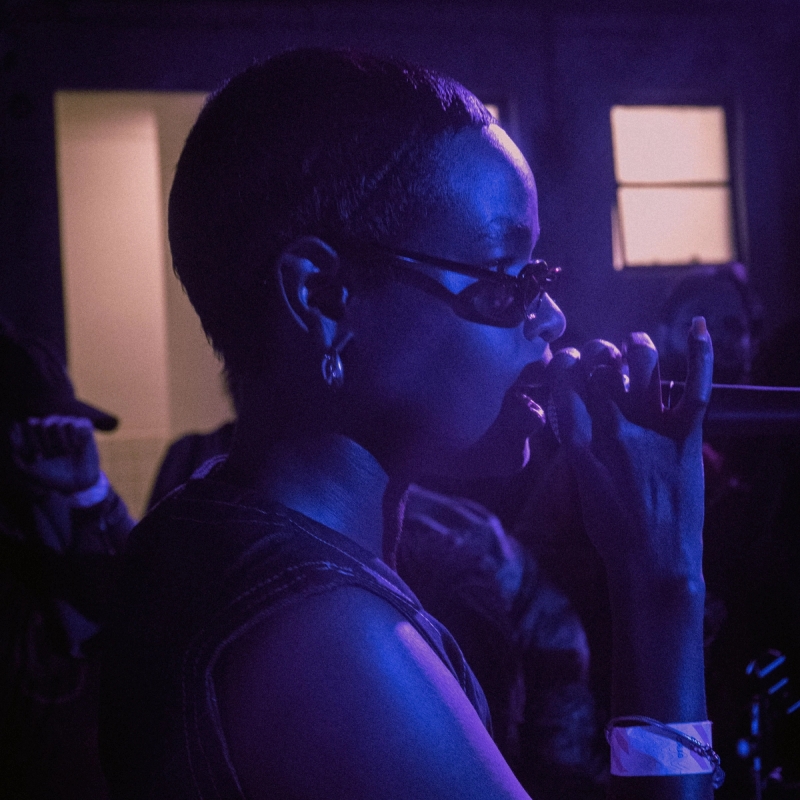
Tai Dai doesn’t chase genres, she bends them. Her music drifts between rap, R&B, and Afrobeats, always anchored by an ease that feels instinctive rather than deliberate. There’s a calm self-assurance in her delivery, the kind that comes from knowing you don’t have to be loud to be heard.
When we spoke, she was reflective but playful, quick to laugh, and just as quick to question her own process. She’s not in a rush to define her sound or wrap it in a label. For now, she’s content to keep making what feels right, and to let the world catch up when it does.
Tai Dai is part of a new generation of East African artists for whom boundaries feel optional and collaboration feels natural. Her songs suggest that it’s possible to be laid-back and ambitious while pacing yourself, even when the world is moving fast.
Eric: I’ve noticed that you’re pretty comfortable rapping over any track. I’m curious to know, what artists inspired you growing up and what artists inspire you now?
Tai Dai: Growing up, I used to listen to what my parents had—so a lot of Motown and Bob Marley. And then whatever was playing on TV, because my older sister used to watch music videos pretty often. So basically whatever was charting.
Eric: How old are you, if you don’t mind me asking?
Tai Dai: Hey. How old am I?!
Eric: Just for context, just for context (both laugh). Who was playing at the time? I’m assuming it was Rihanna, Chris Brown, and other similar artists from my childhood.
Tai Dai: Okay, yeah, I’d say so. Later on, when I started actually listening to music for myself, I got really into Tyler, the Creator, Frank Ocean—even Miguel! That Kaleidoscope Dreams album was great.
Eric: What was that? Like, 2018?
Tai Dai: Oh, no. Way before.
Eric: 2015 maybe?
Tai Dai: Even before that. I think either 2012 or 2013, around the time The Weeknd Trilogy came out.
Eric: 2012, actually. You’re right.
Tai Dai: Yeah. Also Kid Cudi.
Eric: So, when I said float on every kind of track, I meant it. Your discography spans rap, afrobeats, afro-pop, dance music, and R&B. While I think it shows your versatility, it also makes me wonder: do you think genre holds the same weight it once did, or have the lines become blurred?
Tai Dai: Yeah, man. I feel like the lines have been completely blurred. I don’t think anyone has to fit into these tiny boxes anymore. I believe they’re quite irrelevant at this point. Make what you like, and people will vibe with you if they vibe with you.
Eric: You’re right. So make what you like. I like that.
Tai Dai: Yeah. Well, you can make it, you know? I guess some people have strong feelings about certain genres, so it makes sense that they only want to make those. Then again, maybe if I create my own sound and start producing, I’d know for sure. Even then, I think I’d cover a range of genres.
Eric: Actually, that ties into the next half of my question. Is there any sound you feel most at home in? Like when you do release an album, will you focus on one genre, or are you going to cover as many as you have before?
Tai Dai: Yeah. I think, for whatever reason, people describe my sound better than I do. I don’t feel like I have a specific sound at all. Maybe it’s because of my tone. I’ve been told I sound laid-back, chill, calm, etcetera. So even when I think something is upbeat, people think it’s super lo-fi. I don’t think I’d ever be able to squeeze into the confines of a genre. But who knows? Maybe I’ll create my own or something along those lines. We’ll see.
Eric: I like that. I’m looking forward.
Tai Dai: You and me both.
Eric: From your lyrics, I noticed a lot of themes of self-worth and refusing to settle—whether in love, friendships, or even the vibe of a party. Basically, in situations where you know you can do better.
Tai Dai: (laughs) Okay, period! I’m glad that’s what’s coming out.
Eric: Does this come from the way you were nurtured? Someone in your life? Or is it what life has taught you—to hold your own?
Tai Dai: I guess people in my family generally have very high standards for themselves and the people around them too. So I think I grew up expecting a lot from myself. I know what I like and what I don’t. And I’m like, why waste time with subpar nonsense when I can just reject that and get to what I actually want faster? I’m not entirely sure, but I feel like I have standards I try to uphold.
Eric: Yeah. It definitely shows.
Eric: Okay. You referenced this earlier, but I noticed a lot of the songs in your catalog lean into slower BPMs. Then there’s Thursday, which is the opposite. What circumstances led to making that track?
(include link to the music video here)
Tai Dai: It happened because of a good working environment. I had worked with Kaboo before (the producer of the track) on another project he and Baru made. That was pretty cool. He wanted to make another beat for me to record on, and he had some vocals from those earlier sessions that he chopped up to try and make for the initial beat. He was like, do you like this? And I said yeah.
This was before it even had percussion, bass—anything. Just the bare vocal chop. I was vibing with it because at the time I wanted to make more upbeat stuff—it’s easier to perform, you can get the crowd riled up. A lot of my stuff before that was doom and gloom, sit-down-and-listen type music. So I was looking forward to switching up the vibe, making something fun, energetic, and lighthearted. I was already in the space of being more open to something funky and danceable.
Eric: That’s nice. It was happenstance. So did the hook come before the beat?
Tai Dai: I think so. The problem is I’ve told the story differently so many times because I don’t fully remember (laughs). I’m pretty sure of what I’m telling you now so if anybody reads this and says, oh, you said something different last time—just know this is the new story.
Eric: As of 29th September 2025 (date of the interview).
Tai Dai: (laughs) There’s a time I went out on a Thursday night and got super drunk. I was causing chaos, man—doing a bit too much. The next day, I was so full of regret I was like, oh my god, alcohol is poisonous.
Eric: Devil’s juice for real.
Tai Dai: Yo! So I think initially I had already written “devil’s juice had me loose on a Thursday” somewhere in my notes. But yeah, I found that during the session with Kaboo and built off that and wrote the whole version in the session. Maybe I had a few bars beforehand, but it was done pretty quick. It was a fun little verse to write as well.
Eric: I like the irony—you came down from a terrible hangover on Friday, then made this banger about turning up on a Thursday (both laugh). It’s cause and effect. Now guys will be having hangovers because of your song.
Tai Dai: Yeah! I can’t suffer alone, man. I have to bring everyone with me.
Eric: Okay. Alright. So, I noticed that you have a lot of collaborations. How do these collaborations shape your own sound? And are there any East Africans you would like to collaborate with?
Tai Dai: Each collaboration widens my range and scope a little because I get to see how adaptable I am and what works for me. You asked what—what did you ask again about the collaborations?
Eric: Do you think they affect the music output that comes from Tai Dai?
Tai Dai: I'm not entirely sure. If anything, it's like iron sharpening iron. I feel slightly improved by every collaboration because I've learnt a bit more and seen how new things can be done. I don’t know if that affects my core sound.
Eric: Alright, a fun one. On your track Some Earl Grey, there’s this line where you say—
Tai Dai: The deep cut.
Eric: Yeah. You say, distance over anger, anime over manga. I love both parts of that line, but let's talk about the second half. This song came out in 2018. Is it still anime over manga? And if so, what were some of your favorites?
Tai Dai: Oh, yeah, it is. My favorites—I really liked Hunter x Hunter, Death Note also. I high key feel like I’ve fallen off and not watched anime in a long time. I didn’t finish Bleach, actually.
Eric: Same, actually. Oh, what a coincidence.
Tai Dai: Oh, yeah?
Eric: Yeah.
Tai Dai: But sometimes there are so many episodes that I get discouraged along the way because my attention span is really short. I tend to fall off. What else have I seen? Oh—Parasyte. I did finish Parasyte, actually. I was thinking about it, I don’t know why I didn’t mention it first.
Eric: Oh, yeah. That’s another good one.
Tai Dai: The problem is if I take a break from watching anything, I’ll never go back to it again.
Eric: I know exactly what you mean. I was watching The Bear—after season two, episode three, and I’ve never—
Tai Dai: Been back.
Eric: It’s been years.
Tai Dai: I don’t know if I finished a whole season of The Bear. It was actually too stressful to watch.
Eric: Too stressful. Too intense. I’m trying to have fun.
Tai Dai: What is all this? Chill, bruh. For real.
Eric: Okay, great. Just two more. We know that being an East African artist comes with its own challenges, especially relative to those in West Africa or South Africa. But do you think there are any advantages to being based in, or at least from, East Africa that others don’t have?
Tai Dai: I can speak more for Uganda than anywhere else. Getting into music was just super easy—it was such a welcoming and encouraging environment, at least in the new wave. I hear the wider industry has a lot of gatekeepers, but in my experience it’s been a really helpful, welcoming community. Everyone’s trying to put each other on, and it feels like we’re moving forward as a unit. Linking with guys from Nairobi and like-minded people elsewhere has been great. It feels less cutthroat, I suppose.
Eric: I see what you mean. Yeah, the industry has a reputation for being shady.
Tai Dai: Very much. It’s been difficult. But so far, I think I’ve probably paid for studio sessions like twice in my life.
Eric: Oh, wow.
Tai Dai: Shout out to all these producers—many have just told me to pull up and use their studios. I was like, what? So it’s been really lovely here. Anywhere else, I think I would have faced a lot more hurdles. Also because our industry is a bit young compared to others. What am I trying to say…
Eric: I think what you’re saying is that because of the state it’s currently in, it’s a lot more welcoming. Whereas in South Africa or Nigeria, the industry seems saturated.
Tai Dai: Yes, for sure. It does seem less saturated here. But in Kampala, it’s easy to be a big fish in a small pond. For now, that’s a good thing as we’re all starting out. It’s a lot easier to do that here than in more mature industries.
Eric: In time, the world will catch up.
Tai Dai: That’s true. But it’s nice to be able to find your footing here first. You get to the bigger pond and be a smaller fish after, once you’re ready and grounded.
Eric: Okay, last question—pretty straightforward. Any plans for an EP or album? Are we getting a Tai Dai collection of songs?
Tai Dai: Yeah… oh gosh. Well, yes. I’ve just been flipping around this for years. I have a project I wanted to put out as an EP, but I don’t know if it has everything it needs. I want it to reflect the full range of what I enjoy, a good showcase of what I can do. It’s not quite there yet. I want to sit with it a bit longer, see what to add and what to take out. But there is a body of work coming. I’m not sure when, unfortunately.
Eric: That’s fine. When you’re ready, we’ll be ready.
Tai Dai: Man, you guys are tired of me.
Eric: They’re not going to be angry if you release music, I can promise you that.
Tai Dai: At least that’s some comfort. I’d be angry if I didn't. So I just need to get my ducks in a row.
Eric: I believe it’s important to let artists take their time. We like the work because you released it when you thought it was ready. That process has to happen. I say the same thing whenever people complain about waiting for a Frank Ocean album—it’s been years.
Tai Dai: Yeah, man, I understand that. Things aren’t as timeless as they used to be. I’m rushing to make sure the work is fully formed. Maybe I’ll even just put out singles—I’m still deciding if I should start that way, just to get into the habit of releasing. That’s also why I have so many collabs—because then it’s not all on me. Releasing is the part that holds me back. So I keep holding on to things instead of letting them go. Maybe that’s a bad habit, maybe it’s for the sake of the art. I don’t know.
Eric: You can separate the two. It could be perfect and still you’re not comfortable with it yet. Or you could be comfortable and it’s not perfect.
Tai Dai: That’s good.
Eric: I don’t know when that magic happens, but I hope it happens eventually.
Tai Dai: Thank you. We’ll see.
Eric: Alright, great. I think I can stop recording now. A small easter egg for your fans: I can confirm the vibes in this conversation were very nutritional.
Tai Dai: (laughs) Okay, good.
Listen to Tai Dai’s single Outside Shoes