in-conversation
in conversation with Akiba
by Keith Mukiri
September 18, 2025

in-conversation
KEITH:
Let’s start with your name, Akiba. It’s such a distinctive name, deeply rooted in Swahili and Kenyan culture, and it feels inseparable from your art. Your studio carries the same name, and to me, your name and your work are constantly in dialogue with one another.
How significant is your name and how significant has it been to your work and how you interact with said work?
AKIBA:
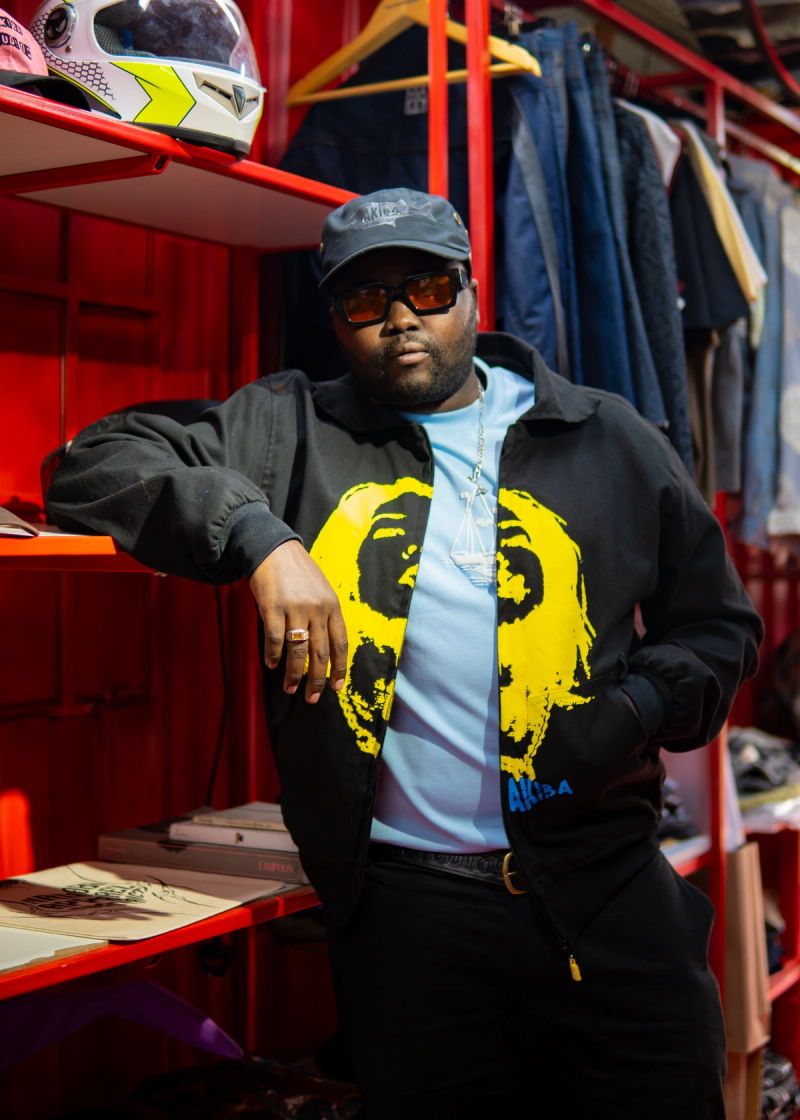
I'd say the name speaks for itself. I think for me, I'm always trying to archive the culture and document the timestamps that we live in currently. So I just want to make a full archive of fashion, art, culture that speaks to the generations to come. Hence the name Akiba Studios.
KEITH:
That's so cool. Does it come from the proverb “Akiba haiozi” (Savings never rot)?
AKIBA:
Yes.
KEITH:
You’re exploring how our culture weaves itself into modernity and this new age, which I think is really fascinating.
You have your hands in a lot of different media forms and art forms. What does being a multidisciplinary artist mean to you, personally and fundamentally?
AKIBA:
I think being a multidisciplinary visual artist or artist in general helps me experiment with different things. And I'm always trying to learn. I'm always a student of the game. So I like learning new mediums, new techniques, new ways of doing stuff. And, yeah, there's a lot of inspiration, especially in Kenya and in South Africa.
I just like tapping into different pockets, you know, learning about Swahili culture, learning about Maasai culture, all these different cultures, and seeing what's significant, what sticks out to me, and trying to experiment with that to create new narratives.
KEITH:
So for you, doing and practicing art is about learning?
AKIBA:
Yeah, it is.
KEITH:
And learning has to be very flexible, hence being a multidisciplinary artist and trying out different things.
AKIBA:
Exactly. You have to try different things to see what makes these things what they are.
KEITH:
How do you balance that eclectic, bold energy in your work with the cohesion needed to bring everything together?
AKIBA:
I think it all stems from my taste. Everything is from my point of view. The things that I've learned before, things that I like, the things that inspire me.
For example, landscapes. Every time I travel, I see different landscapes in different places. And you can see how nature is the true design. Design-wise, nature is everything.
The ocean, the mountains. Everything is cohesive. My work is very vibrant because of that, and it still finds its grounding in merging all this.
KEITH:
Just like nature, you don't try to structure it. Let the chaos brew.
AKIBA:
Yeah, you let it brew. Like living in Nairobi. Nairobi is a very diverse place. It's a melting point of different cultures.
And it all comes together because, while it may come from one brain or one point of view, it draws on multiple perspectives that have been approached from different angles or levels of interpretation.
KEITH:
Yeah, because fundamentally we are all the same and through those similarities, we can then branch out.
AKIBA:
Exactly.
KEITH:
I love that.
You founded Akiba Studios in 2020, and as someone who's been in the industry for a while, I'm sure you were doing stuff even before founding Akiba Studios.
What are some of the values and beliefs that, as you've evolved, you’ve chosen to retain on this journey? And what are some that you've decided to let go of or unlearn?
AKIBA:
From my journey so far, I'd say staying consistent has helped me a lot. Sticking to what I believe in, my morals and my compass, just staying true to that.That's one thing I'd say I've retained over time. As for the things I’ve discarded, I’d say looking for validation from other people.
You know, I think as artists, we try to create, but we face so much criticism from the structures of the systems around us. They tell us to do things a certain way and they kinda put us in a box. So that's the other thing I'd say I've discarded. I'm doing things my own way, with my own techniques, with my own timing. And just trying to make it better over time.
KEITH:
So for you it's all about retaining authenticity while being unapologetic about it. You can't make true art if you're too worried about the criticism. The criticism is part of the artistic process.
AKIBA:
Yeah, and there's good and bad criticism, but at the end of the day, it's your choice. What to embrace and what to let go of because nobody knows how things are gonna be in the future, or what techniques are going to evolve. And I always say this: you'd rather be progressive than a perfectionist.
KEITH:
"Rather be a progressive than a perfectionist.”
Earlier this year, you brought your vision to life once again by partnering with Braided Nairobi, which brought such a fresh and vibrant outlook on hair and what it means to our culture. It offered a refreshing perspective on embracing the African context with creativity. How have your cultural roots and background as a Kenyan and an African, especially within western-influenced society, influenced your own journey as an artist?

AKIBA:
That's a good question. From my upbringing, my parents and the generations before me, I've tried to nurture the essence of what I was taught and just preserve that. That also brings a unique point of view in how I see the world and the stories I want to tell. So yeah, I think it's interesting that things have developed the way they have, because I never thought I'd choose this career path.
For example, the Braiding Nairobi concept was very random. But in my work, there have always been elements of hair, tradition, and ways to manipulate that. So I think it was a good opportunity to work with them because I felt like I've always been known for streetwear. For that project, I specifically wanted to do something a bit avant garde with costume design and also play around with hair. The power of community brings ideas together because I can't do everything alone.
KEITH :
I love that you put yourself in a different platform to push your creativity to its absolute limits. Just to piggyback on what you've said about community and, you know, being a big player in the collaborative space, we see you in various collaborative campaigns, and I love that so much because it shows this Ubuntu essence, which is very refreshing to see.
How has that philosophy influenced you personally as an artist and human being within this industry?
AKIBA
When I was starting, I was very self sufficient because I was creating art on my own. But when I entered the fashion space, I realised, “oh, you need to work with a tailor.” I need a photographer, videographer and all these different elements. And, you still need to stick to your vision while helping others adjust and learning from them. It's been beautiful to see that growth and work with other people, because while I have my own perspective on things, I also get ideas from others. I think it is very important.
KEITH:
It's almost like looking through a mirrored glass because from your perspective, you're seeing yourself, but from the other side, people are seeing something completely different, through another line of vision.
AKIBA:
It's like you said - it's like a mirror. It helps guys see themselves as well. And through my art or fashion, I've always wanted to be a voice that helps others also find their own path and their own voice.
KEITH:
Like Snow White. Mirror, mirror on the wall.
AKIBA:
Exactly.
KEITH:
More often than not, creatives and artists come into the industry with a chip on their shoulder, feeling like they have something to prove. At times, this can come with a certain roughness or abrasion. Has this been part of your own journey? If so, how have you managed to handle that self-induced pressure?
AKIBA:
I think when I was starting out, there was a lot of pressure because we didn’t have any mentors or pioneers in the game, especially in streetwear.. So it was very tough. There was a lot of competition. Everybody's trying to outdo each other, but I think it was healthy
There was competition at the start, but as you grow, you realise that you have to stay in your own lane. You have to create at your own pace. Even when I was starting, I felt like I was making dope stuff, but I wasn't reaching my full potential. And sometimes you get too comfortable as well.
When you start comparing yourself to other people, you get comfortable. Maybe you're at the top of the game, but you’re satisfied just being there. So I decided, that's not for me.
I started to do things at my own pace, trying as much as possible to perfect the craft I’m working on and just see what happens because everybody's journey is different, you know?
KEITH:
True. It definitely takes a lot of humility to set yourself aside from the rest, and to understand that focusing too much others might make you lose sight of your vision.
AKIBA
For sure, for sure. Because I feel like your vision can also get corrupted, you know? If you start looking at how European brands are doing things, or how Asian brands are doing things, you might get caught up in the trends and and then you end up losing your own vision.
KEITH:
That's true. You've mentioned how, starting off, you didn't have mentors or pioneers in the industry. Do you think that's something we need in the Kenyan creative scene - a collective of mentors and pioneers to help the coming generation?
AKIBA:
I think it depends on what they're offering. For us, we had very few guys who showed us the ropes. But I feel like right now, there's a lot of guys who are doing what I'm doing.
For example, you have your own brand. You're on your own journey. I feel like, right now, you're in a better position. You could come to me. You can ask me questions on how I did things. And I'll give you advice.But at the end of the day, my advice may not be specifically tailored to you.
You have to find specific things and apply them in your own way. That's what I'd say in terms of that.
KEITH:
Oh, so, a baptism by fire is also very necessary because there's some mistakes you'll probably only understand if you actually make them yourself. Rather than learning from someone else because when you get that, you have that personal lesson.
AKIBA
Exactly. You'll continue learning from them and applying them. Everything is very personal but you can always learn from other people.
KEITH:
I love that. As a multidisciplinary artist you dabble with so many concepts and philosophies before they come to life.I just wanted to know how you usually breathe those visions and concepts into life? What does that process look like?
AKIBA:
I think the process of coming up with concepts usually starts as a moment, a spark. Sometimes I don't even think about it too much. Maybe it might take me like a year or two while it's just brewing in my head; in my consciousness. Then I figure it out. I join the dots and realise how it should be. Maybe an idea sparked from a moment so it could be utilized for certain concepts.
KEITH:
So it's more of a reverse engineering.
AKIBA:
Yeah. I reverse engineer moments, sparks or things that inspired me previously, and then bring them to life in concepts and ideas.
KEITH:
So it's all about being patient and holding on to that moment, and then gathering various references to just build upon it until it shows results.
AKIBA
You might see somebody on the street with a nice jacket, and then a year later you think to yourself, “oh, why did I find that jacket really nice?”
Then you start noticing elements of the jacket. Maybe it's the sleeves, maybe it's the graphics, maybe it's this and that. And now you can come up with a concept based on one element.
Eventually it becomes tangible after I finally sit down with it and understand it.
KEITH:
As a budding creative, I think you're definitely, as I said, an inspiring figure in the scene. I'm curious to know what's next for you as Akiba and Akiba Studios. What can we expect from you in the future?
AKIBA:
So currently, I'm working on a new collection.
The collection is basically about evolution. The title is Cotton Avenue.It started off as a pipe. You know how people need a bridge to cross from one side to the other?
It started like that. It's basically a road. Guys just start walking on it, then they decide to build a foot bridge for more people and then they build a bigger bridge for the cars and eventually, it ends up being a massive bypass, you know?
So this next collection is basically about that. We're trying to show the evolution of the brand from statement pieces, prints, to our plain, constructed pieces.
Currently, we're doing a rollout for it. We're gonna have a 2-D game. I'm collaborating with one of my friends who worked on one of my films which was called Ace for Akiba. It was a game-inspired film. So right now, we're bringing the game to life.

KEITH
That's amazing. I can't wait to see how it looks.
AKIBA
Yeah. I'll show you.
KEITH
So Cotton Avenue is basically a compilation of stories personally curated by Akiba.
AKIBA:
For sure. Everything I do is like a collection of stories. I like naming them as chapters of a book. Cotton Avenue is just one chapter. We're doing a volume one, which will be a continued series of capsules.
That will speak for the brand as we continue.
KEITH:
That's so amazing. I love the idea that you're constantly evolving, and you're allowing your community to be part of that story.
Because I'm sure as people look at the pieces, the most loyal parts of your community will also see themselves reflected in them.
AKIBA:
Especially people who've bought from me previously. They’ll recognize certain elements that they saw when they first bought a t shirt or whatever.
It's the evolution from then until now.
KEITH
As a fellow creative, I'm fascinated by how you look at creativity and art form. You have a certain element of care to your work, and I think it's something all creatives need in their own work. Since the scene is growing and right now we're seeing collaborations across the region, how would you describe this current scene in Kenya and East Africa?
AKIBA:
I think it’s really beautiful. First things first. I think for young brands to come up, old brands need to continue growing, and have this regional movement.
I think it's beautiful. I feel like East Africa hadn't had its time yet in terms of art and fashion but right now guys are telling their stories. Guys are doing content that speaks directly to them, their communities - and the world is kinda catching up. I think that’s very beautiful. I like the growth and I like that there are always new brands coming up and new ways of feeling inspired by the culture.
I really enjoy being part of it, and seeing the community and culture grow. Fostering collaboration is so beautiful because we're one Africa. We're one nation, and that's how we should continue doing things.
KEITH:
I’ve been truly honored to have this interview, Akiba. I haven't gotten the full story yet, haha, but I'm glad I got this inside scoop on Cotton Avenue and a chance to pick your brain as a fellow creative. There's so much more to come, and we're excited to see it.
As a parting shot, from your perspective, what we can do as a magazine to promote the Kenyan creativity and showcase more of what's going on in the creative scene.
AKIBA
I think you guys are doing it already. I'd say continue doing editorial work; documenting concepts and ideas.
There’s so much here, but a lot of artists get distracted by European or Western mindsets. They start copying what brands like Corteiz are doing, even if that doesn’t work here. We have so many different cultures that you can document and bring to life, showing people what’s authentically ours.
Whether it’s in short films, editorials, concepts, shows, or events, there’s so much we can still tap into and show the world. That this is what we’ve been living.
KEITH:
It's all about authenticity and looking for reference points that truly speak to you.
AKIBA:
Facts. That's what my brand is about. I don't try to be any other brand. I just do things my own way. I also love that other creatives are doing things like that. Guys are releasing short films that show our childhood games or, or show how we used to live in a certain time.I think that's just beautiful.
You’d be surprised how the world relates to these things. Some games are played everywhere. Some stories resonate across cultures. Maybe you’re documenting something here that speaks to your community, but someone in a village in Asia might relate to it too. It just hasn’t been documented globally.
KEITH:
That's true. I think that perfectly encapsulates what we've been talking about.
One single story can tell multiple narratives.
AKIBA:
And can touch many people. Many people can relate as well.
KEITH:
Yeah. There's so many people looking for connection and we're definitely able to offer it to them. Thank you so much Akiba. This has been so insightful. I'm very excited to see what you have going on next.
AKIBA:
For sure.