writers-pit
A EULOGY FOR MOOV: THE CASE FOR MORE THIRD SPACES
by Hafare Segelan
August 11, 2026
writers-pit
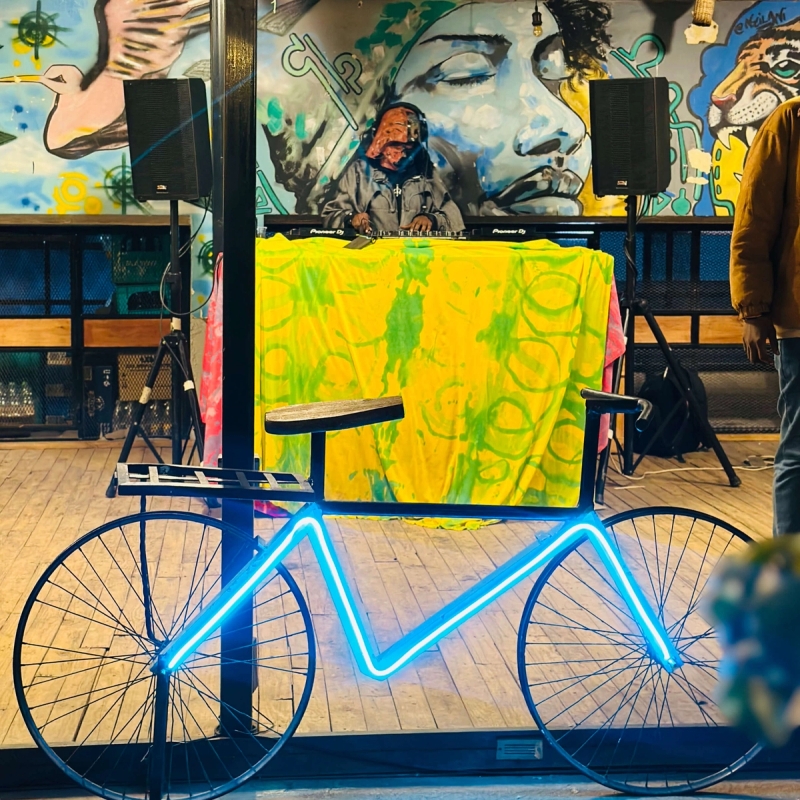
Langata Link Road makes me sad. I feel a bit forlorn whenever I use it because it once led to my favourite hangout spot in Nairobi, Moov Cafe and Bistro. Moov was a true hidden gem. Tucked in the corner of a lot, hemmed in on all sides by towering buildings, and featuring a car wash rarely used by its patrons. It was the type of place that you passed everyday without a second thought. For a lot of us though, it was our third space.
The term third space, coined by Ray Oldenburg, refers to a familiar public spot where you regularly connect with others known and unknown, over a shared interest or activity. He coined this term in the 1990s when increased social stratification within American society led to the decay of long-standing community hubs. But the idea itself is much older. Even before the industrial revolution, roadside inns and cafes were dubbed “penny universities,” places where rank, status, and literacy level did not matter and anyone who walked in could sit at the same table for the price of a cup of coffee and freely exchange ideas and conversation. A third space, in essence, is neutral ground, a sort of social demilitarized zone and leveler of status where the only thing you have to do is be the most authentic version of yourself.
That was what Moov was to me, at least. It was a place that felt natural, where even if you didn’t know my name, you had seen me enough times and would acknowledge my presence with a casual head nod. The waiters knew me by name and my order by heart. One coldBalozi as soon as I stepped into the place, and if I was there long enough to get to my fourth beer, they would slip a shot of jaba juice just to keep the good times flowing (Shoutout to Petiole, you’ve made many nights great). There is a feeling of psychological ownership that this constant repetition builds, the sense that you are intrinsically connected to a space because it recognizes you back. That’s what a head nod from a stranger and a waiter who remembers your order actually does. It tells you that you belong somewhere. There.
What made Moov great wasn’t the drinks or music, you can get that anywhere. It offered a space for like-minded people to gather easily, frequently, affordably, and pleasurably. It was a place to exchange ideas and release pent-up emotions from the rest of the world, an alternative to the light ennui that had become characteristic of everyday life. Moov was always there and, except for a few select evenings, it cost nothing to simply hang out. That accessibility made it one of the most diverse places in Nairobi. They would play the songs you rarely heard and the crowd cut across all social circles in the city. On one table you would find the biggest relationship podcaster in Kenya, on another one you would see a babe dressed up like a stereotypical witch but was secretly a wicked DJ. And finally in the corner was the tech bro who worked at Google and knew anything you would ever need to know about rugby.
The seating at Moov was limited, so you slotted in where you could, usually next to people you didn’t know and sooner or later you would be deep in conversation with them, the atmosphere making it easier to lower your guard and be more present in the moment. And that repeated every single time you were there, eventually reinforcing the idea that Moov was a place you could go to at any time and still find your tribe, even if it was someone you had never even met before.
Unfortunately, for reasons that remain unclear, Moov pivoted away from being the social hub that brought all of us together and tried to compete with the more established joints that pepper Kilimani. They couldn’t survive and in time the building that was so dear to me was torn down. I have never bothered to find out what replaced it. Its disappearance felt personal, but it also reflected something much larger happening across the city. Moov and many other spaces like it are the unintended victims of a society that is moving away from informal gathering spaces and shifting to more ‘curated’ experiences.
The pandemic made it easier for people to never leave their house, work from home and delivery apps have basically made being outside a once-in-a-while experience. In addition to this the rising cost of living, gentrification of traditional working-class neighbourhoods and the shift towards large centralised shopping and social spaces has led to the death of the third space. Social halls have been replaced by apartment blocks, the local bar was replaced by a boda boda charging station and the local church folded because most of the congregants moved to the megachurch next door. While this is inclusion into a larger group, it also feels more isolated, where you are just another name on a list and not a person that everyone around you has interacted with. And the spaces that do survive this shift tend to survive by becoming exactly what a third space isn’t, curated, expensive and selective about who gets to walk in, which means the people who need a third space the most are often the ones priced out of finding one.
At the end of the day, Moov represented something that this city needs. A place to go to that welcomes you and allows you the freedom to be yourself. A space that feels like a home away from home. It can be a social hall, videogame arcade, pool hall, church, nature trail or in my case a small bar tucked away in the heart of Kilimani. Your third space is a refuge from the endless doomscrolling, the constant barrage of the 24 hour news cycle, the dizzying doldrums of everyday life and so much more. They allow us to show up even at our worst and still give us the space to be ourselves again. They allow us to build community, foster connections and grow our friendships without having to worry about the performance of being alive.
In a city that hums and moves as much as Nairobi does, it is inevitable that third spaces become more limited. But that isn’t a reason to shrug it off as the cost of growth. It is a reason to protect the Moovs still standing, and to notice, before the wrecking ball shows up, that a nondescript bar with a car wash next door might be doing more for this city than the hyped-up pubs, hookah lounges and curated events ever will.