in-conversation
IN CONVERSATION WITH NITAKACH0
by Muthoni Kariuki
May 13, 2026
in-conversation
“NitaKacho is not actually me.It's the person, the client, the one who comes to the visual one.NitaKacho is basically satisfying the client’s desires.”
I had the honor of having a conversation and digging around her brilliant brain. Muko who describes herself as a little woman, a sister. anda dog mum takes us through her process, journey and a little bit of who she is beyond the beautiful sets she designs. Here’s Nitakach0’s story:
What influenced you to become a set designer?
I was already doing it really. I just didn't know what it was called. It was more like default.I was always decorating my room and switching it up.What I didn't know was if itwas a career path or justidentity. But I was already there.
When working withlarge crews, how do you usually ensure that everyone’s ideas and your ideas are aligned and implemented with minimal to no clashes?
Honestly there’s different processes.When the client initiates the conversation, and asks me to join the crew, we usually havea recce during the first few days. We have a director who we all try to make theirvision come true. So at least we have one place where we're like united in during the whole process.
When Igo for the recce, I really pay attention to what each and every department is doing, especially lighting and the camera, on where and how they'll be shooting the place in itself.I like to be really present when we are all putting our heads together.
I also ask a lot of questions so that I don't just go there with my mind. I realised that whatyou understand is not what somebody else has understood.
From music videos to commercials to podcasts and many more, is your process different depending on what type of set you are designing or does it remain constant?
Definitely.Different shoots take different times. You can find out about a shoot today and have to do it tomorrow so it’s not possible to have a full process. However, you always have to create a mood board so that everybody knows what we're talking about. When we can do thorough preparation, the recce has to be done so that our minds can align. Like this is where we're going and this is what we're doing.. Honestly some processes really remain the same, considering the time and the kind of work that is needed.
Your work has touched different parts of this industry. How has every set you’ve worked on shaped your career and experience ?
It has affected me as a person as much as it has affected my career. I ammore alert, and I notice a lot.Set design is like a mirror of society, not just mannerisms, but also material things . When I was beginning, I was a blank slate. I didn't know much. All I knew is that I had desire and what I've been told is what we are doing today. I was so open and just trying to understand how things work.The more I diddifferent sets, the more I realised that I'm not in the same placeI was before. Now I understand so much more and Ican add to it. I understood how to work with different clients, how to place items in different settings, and overall it gave me an understanding on why things are the way they are in society. I genuinelygrew in different sets and it made me such a team player. I grew more curious and was more open to learning. It made me understand howdifferent departments work and how to work with those departments.
You worked on a Netflix Film. Was that one of your defining moments in your career ?
Different sets have been defining moments. I don't think I had a set that was like, oh, this was a defining moment. However it was a defining moment for me in film. This was like my second or third time in film proper. At the time I did not even know that it was going to be on Netflix. To me it was just another job that I needed to fully immerse myself in.I found out about the job the day before and I was doing both styling and set design. I didn't know about money and I didn't know about production.So It was tough. I studied the whole mood boardand I asked so manyquestions. I called the people and I was like I can style it, what do you need? What do you have? What are you wearing?The experience sharpened my iron, because I was able to see how different departments ooze into each other. You see, when I'm styling, I'm also thinking about the colours. I'm thinking about what if this gets damaged? How am I going to clear that?It was a lot, really.
Personally one my favorite sets that you worked on was the Rudia Music video. How was your experience working with a library and shifting it to such a beautiful set?
Oh, my God. I love that set, too. First of all, I must say it's such an honour to touch such things.It felt like I'm touching history. I'm playing around with places where people could not walk into before but now it's just a normal place.You can pay 20 Bob to study there for an hour. For me, touching those things, the books, the shelves and with so much care because you're not going to move that shelf.If you move it, it's going to break and that's history. You've messed it up.
I had been to the librarybefore and I knew if I get an opportunity to work here, I'm just going to do my best. I was alsoworking with Matete, Odede and Xenia. Those people are amazing. It's like working with friends.Also remembering the director has his own vision of what he wants to shoot and it's very easy for him to be like, ‘I've got the shots I want. Can we go?’But in my mind, I was like, let me give you an art piece. We're not going to come back here the same way, with the same light and with the same energy. So we went for a recce with Matete. We checked out the place. He loved it. We created a mood board about it. And all I can say is it was fun.And to work with Greg, who did thelighting, whowas like, ‘unaeka hio paper wapi ? Naweza chapa hii light iende hivi?’Everybody was so into it like there was no tomorrow. It was magical, honestly. It was just such an honour to work in such a place.
You usually fully immerse yourself in every set you work in. What’s one set that you think you really lived in from conception to execution?
That's definitely Yoshita. I was there for a month and it was so beautiful. When Anil and Mbaala brought me the idea for culture, I looked at the mood when I was like, what? And in my mind, I was like, I don't know anything about Indian culture, leave alone the wedding. I had to do so much research.
I took time to meet Anil and we went to his grandmother's place in Nyeri. Tulichukua kila kitu, we literally stripped the whole house down. We carried beds, mattresses, photos, and the shrine for his grandmother. I got to talk to his dad and it was all so aligned. He gave me advice for things I've been thinking about. I didn't even ask him but it’s like he just knew. When we came back to Ngarawe were setting up different things every day andcleaning up the props. I was definitely challenging myself. The things I thought I knew were put to test.
It was not one of those things that you run towards. It's like a slow burn because everything has meaning. Each and every prop had to make sense why it was there. Each room was very unique andneeded to be functional. There was a scene where we're washing this lady in a big karai and functionality comes in because where isthat water going?If not, all that water is going to flow to all the sets, cut to the camera andit would be a mess.
I really had to think ahead. I also had to make sure things look beautiful for the camera.There's this time we were having an uncomfortable situation where art pieces were hung huko juu, but I was like, ‘Anil, I'm putting these down here’. I knew ifI put the camera in front of the muse, it would cut that frame from above. I had never done anything like this, but I had so much trust in it. I had to explain to my fellow people so that it doesn't cause a blockage and it doesn't worry him. All I wanted to do is give him beauty and put mirrors everywhere to make it like another portal for Odede to shoot through it.
I learned so much about culture. There was so much love.. You might think it's just a pretty thing they're doing, but it has so much meaning.Being in Yoshita for a month was nothing short of beautiful. It was a lot truly.I also got to see my city,I would get to town and walk all the way to Ngara cause I was a bit broke. I saw downtown and honestly, I was enjoying the hooting, the people going everywhere. I was having a blast.We even went to Eastleigh and I reallyimmersed myself in the different cultures there.
Let’s talk about Metal. Was it easier for you to execute something where you were the muse this time?
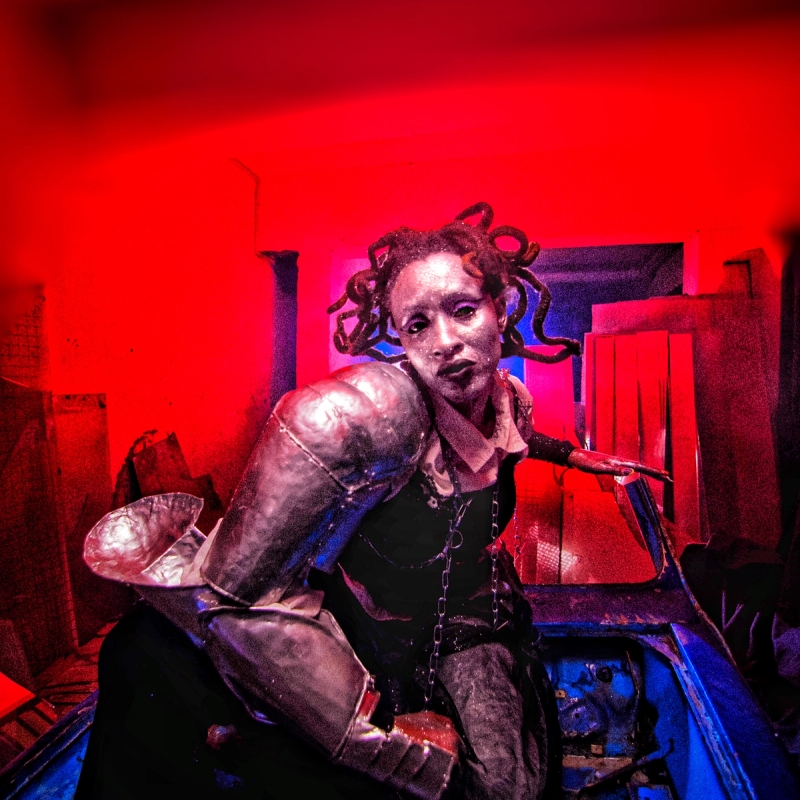
It was a challenge but I think it was easier to do it because of my friend Heri. The understanding that we had. left me no other choice but to execute that.Directing and being the muse is not easy becauseyou have to self-motivate. You have to understand what you're doing and how to do things differently at different times. Creating the armour, styling, and visualising the muse andthe carin the set. I did them separately so that I do not impose on myself.I had to learn how to separate these roles. If I'm the muse, I forget I'm the director. I have to feel,detach, and bepresent by understanding that everything happens for a reason. It made me realise that there’s no bigger role between these two and they all depend on each other.
It wasgiving up control and understanding that I don’t have to be at 100% all the time. Honestly, that's why we were doing metal because metal was about being authentic, being certain of each other, trusting your friend, trusting who you're working with, and trusting yourself. Iron sharpening iron.I mustn't control you and you mustn't control me.All I can do is control myself so that I can appear authentically. It’s pushing yourself to do better. It was the ability to detach, understand what you're doing and understand that there are people around you and they also have needs.
What is community to you and how has your community shaped your journey and work ?
I definitely found community in the entertainment space. I respect it, I love it. I've been able to find my own place, There's no set designer without the audience. There's no set designer without a place or someone to shoot it. I personally choose my friends wisely. Or rather, I'm still choosing.I really choose where I'm going to be. I realised that what you continue to exist in affects your being.
Community is like the biggest deal because you're able to learn from those around you. You're able to do better, to be true to yourself. You can alsosee yourself. You can't be in a community that does not withhold you. It's a learning curve. I'm slowly learning about community, the people I work with, the people I'm able to create with, the people I can help, the people I can listen to.
Everyone has a favorite project that they have worked on. What’s one project you think holds such a special place in your heart?
There's a set I did when I really chose to be me. It's not the best nor is it so cool. It wasn't about that. It was aboutwhat it signified. The set is called Deconstructed Narrative. It's one of the first sets I did. It really mattered to me because the week before, I was at my lowest. That week I had just moved back home and I could feel myself burning. My mindset is the thing that kept me going.I refused to be small. I refused to not have. I refused to lack.I constantly told myself that I am enough.
One day I was going to town and I saw a broken house with the roof open and a tree had fallen inside it.I knew exactly that’swhere I wanted to shoot. Nilishuka hio matatu and I went back home. I took jackets that I had bought from Toi for like10 bobor 30 bob, put them in asuitcase and went back immediately. Then I met my friend called Petu on the way. I think he was going for his graduation. I told him, bro, if you comeand shoot me, I'll drop you on the way.
We got there and found out that the place belonged to the police so we had topay them.It was a lot of hustle butI'm telling you, nothing could stop me. We finally got in and I posed while holding the tree. The whole house being broken wasme breaking, and decontracting my narrative. I hadrefused to not see myself. Ifothers cannot see me, fine. I refusedto be small and I refusedto lack. I wasn’trich the next day andpeople didn’t give me stuff to do. The feeling that was inside me, however, you can't buy it.It's like I was born again and I was tapping into myself fully. The craziest thing was a few weeks after , I sawthe same words in Virgil Abloh's project. It was called deconstruct the narrative. I thought that I wastripping. It gave me more fuel. Just saying that I'm enough. Just saying that I see myself, was reallylife changing.
How was it working with a South African companyfor the KFC Commercial you did. Was it different from the Kenyan companies you worked with?
It was such a surprise. They got me on Instagram and I thought it was a scam. It was an affirming time, but at the same time, I was going through so many challenges.There was a Kenyan company that was hosting them and of course they had their own art director so when I was called they were like who the hell is this? When I went for the meeting. I did not know much but it was so aligned because everything I did at Yoshita was preparing me for KFC. It was crazy. . The lady in charge of art direction, such a lovely lady called Ciku, held my hand andtook me to the conference room. Everyonethere kneweach other and I was very new. She told me not to let anybody feel like I do not belong there because I did. Those words lifted me so much. I was almost crying. I made a whole mood board with my phone on a nduthi, on the way there. When it was my time to present it. Everybody was putting down their laptops. andlistening. It was so scary. All photos there were my own shots from when I was running up and down in Ngara during the Yoshita season. It was so aligned and so beautiful, but so scary at the same time.
It was the biggest job I've ever done because we were talking about 200 to500 people, creating a whole jam in Kiserian. It was more like a learning curve too, andan eye opener. Working with Zintuli, the directorwas amazing. In fact, he loved the clothes I was wearing and wanted one of the muses to wear that.He even assigned me to do bothwardrobe and art, which was shockingand people were not so happy about it. In my mind though, I was going to honour whatever he said. It was tough doing two departmentsbut it taught me how to work with people so as not to clash.
To be honest I put myself back. Once I leftthe house, mambo ya nyumbani niliacha huko . Now I'm waiting for calls and if this person on the other side says, hey, we need this replaced, I go. No excuses. It was doing the job and then you look back and you're like, wow, I see why we had to do all this,It was such an honour also to be seen from Instagram. We have no connection whatsoever. The work I have done just speaks for itself and gets me into such rooms.
From 2021 till now it’s truly been a life changing journey for you. What’s one thing you wish you knew when you were first starting out that would have made it a bit easier for you ?
My mind has to be all right.I learnt that there has to be a balance with my mental health, spiritual wellness and other parts of my life. Always asking myself questions like “Are you always constantly beating yourself up? Are you always feeling less? Are you mirroring the less feeling? Where's your mental health? Do you seek God?” These are things that I find necessary forpersonal development. Constantly learning new skills and honestly most of what you need to be an independent and safe artist.Financial information is something that I have learnt is really important to survive and to protect your future, protect those who are with you and also protect yourself. You need to know yourself and have the ability to delegate time and effort toall these areas of your life. If I was to advise anybody younger, I would say you are enough. You are enough where you are, stick there. It is exactly where you need to be.
What’s next for you? New projects? What’s there to watch out for this year?
That's a secret. Let's just say I'll be entertainingyou for a minute. I feel different because the more I've been in sets and the more I've been doing production and the more I've understood other departments. I would like to connect with such people to elevate my art. So that's what I'm doing this year. And most importantly showing up for the people.